Hair care
Understanding Ingredient Labels
Know What’s Inside Your Hair Care Products
By EBIAL Team · Sep 25, 2026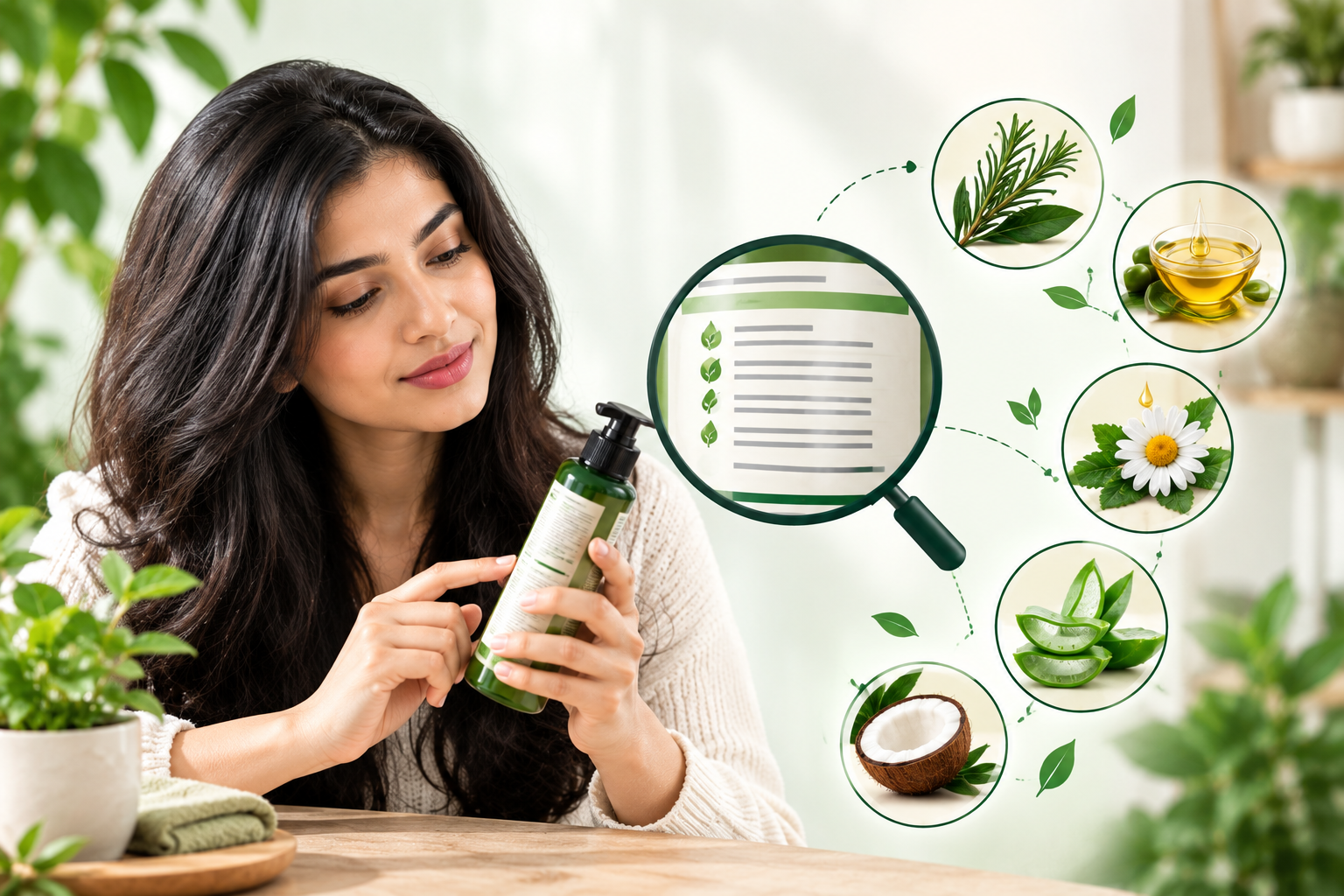
1. Start With the First Few Ingredients
Ingredients are generally listed in descending order of quantity. This means the ingredients appearing near the beginning of the list are usually present in larger amounts.
For example, if Aloe Vera, Water, or Botanical Extracts appear near the beginning, they form an important part of the formulation.
Tip: Don't judge a product only by one highlighted ingredient. Look at the complete ingredient list.
2. Look for Ingredients That Match Your Hair Needs
Different ingredients are used for different hair-care purposes.
For Dry & Damaged Hair
Look for nourishing and conditioning ingredients such as:
Aloe Vera
Shea Butter
Coconut-derived ingredients
Plant oils
Conditioning agents
For Scalp Care
Ingredients commonly associated with scalp-focused formulations include:
Rosemary
Tea Tree
Aloe Vera
Botanical extracts
For Hair Nourishment
Look for ingredients such as:
Argan Oil
Coconut Oil
Botanical oils
Plant extracts
Conditioning ingredients
The right ingredient depends on your individual hair and scalp requirements.
3. Understand the Difference Between “Natural” and “Effective”
An ingredient being natural doesn't automatically mean it is suitable for everyone. Similarly, a laboratory-developed ingredient isn't automatically harmful.
Good hair-care formulations often combine nature and modern cosmetic science to create products that are stable, effective, and comfortable to use.
That's why it's important to look at the entire formulation, rather than focusing on whether an ingredient sounds “natural.”
4. Don't Be Intimidated by Scientific Names
Some ingredients may have names that look complicated.
For example, cosmetic formulations can contain:
Cleansing agents
Conditioning agents
Preservatives
Humectants
Emulsifiers
Botanical extracts
Fragrance components
These ingredients each have a specific role in the formulation.
The important question isn't whether the name sounds complicated — it's what role the ingredient performs and whether the overall formula suits your needs.
5. Check What Your Scalp Actually Needs
Your hair length and your scalp may have completely different needs.
If you have an oily scalp, you may prefer lightweight formulations designed for cleansing and scalp balance.
If your hair is dry or damaged, you may look for richer conditioning and nourishing formulas.
If your main concern is hair fall, breakage, dandruff, or frizz, choose products formulated specifically around that concern rather than simply choosing a product because of one popular ingredient.
← All journal articles